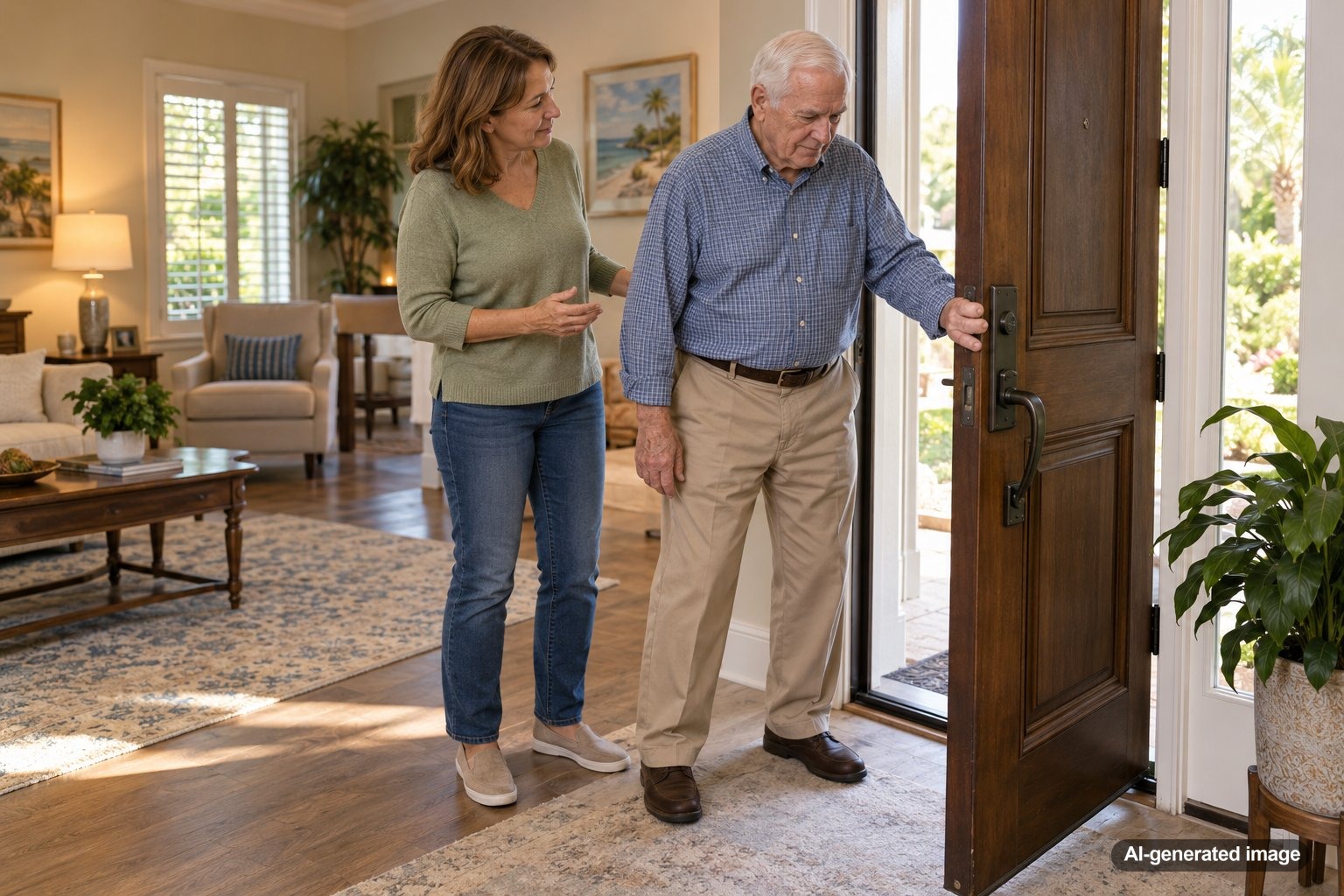
A heavy front door, storm door, patio door, or fire-rated apartment door may seem like a small inconvenience until an older adult has difficulty generating enough force to open it while also staying steady. For someone dealing with weakness, reduced mobility, or balance challenges, managing a heavy door can become a complicated daily task involving pushing or pulling, stepping backward or sideways, controlling the door’s movement, and crossing a threshold at the same time.
This does not automatically mean a person can no longer live independently. It does mean families may want to pay attention to how doors fit into the larger picture of daily mobility, home setup, confidence, and safe routines.
Quick answer
- Heavy doors may require more strength, balance, coordination, and reaction time than families realize.
- The challenge may become more noticeable when an older adult must pull a door while stepping backward or manage a door that closes quickly.
- Watch for hesitation, grabbing nearby furniture, losing balance, avoiding certain entrances, or asking others to handle doors.
- Simple environmental changes, different routines, mobility support, and professional evaluation may make everyday entry and exit easier.
- Door difficulty is worth considering as part of a broader aging-in-place plan rather than viewing it as an isolated inconvenience.
Why a heavy door can be harder than it looks
Opening a door is a multi-step movement. A person may need to reach for a handle, grip and turn it, generate force, shift body weight, move the feet, hold the door in position, and pass through the opening. If the door begins closing before the person is completely through, another quick adjustment may be necessary.
Weakness and difficulty with walking or balance are recognized contributors to fall risk in older adults. A heavy door can add another physical demand at the exact moment when a person is already changing position or stepping across a threshold.
The direction of movement matters, too. Pulling a door toward the body may require someone to step backward while maintaining control of the door. Pushing a stiff door may encourage leaning forward. A screen or storm door that closes rapidly can create pressure to move faster than feels comfortable.
Why families may not notice the problem right away
Door difficulties can develop gradually. An older adult may compensate without talking about it. They might use a shoulder to push a door, brace against the frame, hold onto nearby furniture, wait for someone else to open it, or simply stop using a particular entrance.
Because these adjustments can look minor, families may overlook them. What matters is whether the person appears comfortable and controlled or whether opening the door has become an activity that requires unusual effort, creates instability, or changes normal routines.
It can be helpful to observe the entire sequence rather than focusing only on whether the door eventually opens.
Signs or situations to watch for
A single awkward moment does not necessarily indicate a larger problem. Repeated patterns, however, may be useful information when families are thinking about mobility and home safety.
- Stepping backward unsteadily: The person has trouble maintaining balance while pulling the door open.
- Using the wall or furniture for support: Nearby surfaces become necessary for stability during entry or exit.
- Struggling with the handle and door at the same time: Grip, coordination, or upper-body effort makes the full task difficult.
- Rushing through the opening: A fast-closing door causes the person to move more quickly than feels comfortable.
- Avoiding an entrance: The person begins using another door or limits trips outside because a particular doorway is difficult.
- Needing frequent assistance: Someone else increasingly handles the door during ordinary outings.
- Difficulty while carrying something: Mail, groceries, a cane, or another item makes managing the door noticeably harder.
Thresholds and surrounding spaces matter too
The door itself may be only one part of the challenge. Families should also notice what happens immediately before and after the doorway. Raised thresholds, uneven flooring, clutter, poor lighting, small entry areas, mats that move, and the lack of a convenient place to pause can make an already demanding movement more complicated.
An older adult may be able to open a heavy door while standing still but have more difficulty when simultaneously managing a step, threshold, mobility aid, package, or change in flooring. Looking at the whole entry area can reveal practical barriers that are easy to miss when each feature is considered separately.
How families can approach the conversation
Conversations about mobility can feel sensitive because an older adult may worry that mentioning difficulty will lead to unwanted changes or a loss of independence. A practical, specific approach can make the discussion less threatening.
Instead of focusing on what someone can no longer do, families can talk about making everyday routines easier. A comment such as, “That door looks like it takes a lot of effort. Is there anything about it that feels awkward?” may open a more comfortable conversation than making assumptions about ability.
It can also help to ask which parts of the task are frustrating. The problem may be the weight of the door, a difficult handle, the speed of the closer, a high threshold, limited room to maneuver, or the need to carry items while entering.
Practical ways the home setup may help
Home adjustments should be matched to the person and the specific doorway rather than treated as a one-size-fits-all solution. Depending on the situation, a family may explore whether the entrance can be made easier to use while still meeting any building, security, weather, or fire-safety requirements that apply.
Helpful areas to review may include:
- Keeping the approach to the door clear and well lit.
- Reducing loose clutter or movable objects near the walking path.
- Creating enough space to open the door without awkward body positioning.
- Considering whether handles or hardware are difficult to grip or operate.
- Reviewing whether an automatic door closer is creating an unnecessarily rushed transition.
- Planning where packages, groceries, or other carried items can be placed before the door is managed.
- Making sure commonly used entrances are part of a broader home-safety review.
Some door hardware, closers, and building features may have safety or code requirements, so families should avoid disabling or altering equipment without appropriate guidance.
How support at home can make daily routines easier
Sometimes the most useful solution is not simply changing the door. The larger goal is to understand how the older adult moves through everyday routines and where small barriers are accumulating.
Home support may include assistance with errands, carrying items, entering and leaving the home, planning less rushed routines, companionship during outings, or observing changes that family members may not see during occasional visits. This can be part of coordinated aging-in-place support built around mobility, daily function, confidence, dignity, and communication with family.
For example, someone who struggles with the front door may also be having difficulty carrying groceries, navigating steps, standing from a low chair, or moving safely while distracted. Looking at the whole routine can be more useful than treating each challenge separately.
Families exploring broader aging-at-home support can learn more about Mind & Mobility and the approach to supporting daily life at home.
When occupational or physical therapy may be worth discussing
If door difficulty appears connected to broader changes in strength, walking, balance, or daily function, it may be worth discussing those observations with a qualified healthcare professional.
Physical Therapy (PT) often focuses on areas such as walking, balance, mobility, transfers, movement confidence, and strength. A physical therapist can evaluate how a person moves and identify areas that may be affecting functional mobility.
Occupational Therapy (OT) often focuses on everyday activities, home setup, adaptive strategies, and ways the environment interacts with daily function. For a doorway problem, an occupational therapist may consider how the person approaches, opens, passes through, and manages the door as part of normal routines.
The American Occupational Therapy Association describes home modifications as one way environmental barriers can be addressed to support participation in daily life. Professional recommendations should be individualized because a change that helps one person may not be appropriate for another.
Think beyond the doorway
A heavy door can be useful as a signal to look at daily function more broadly. Families may want to notice whether other tasks are also requiring more effort, more time, or more support than they once did.
That might include walking from the car to the house, carrying items, stepping over thresholds, navigating stairs, getting up from chairs, using the bathroom, preparing meals, or moving through the home when tired. The goal is not to search for problems. It is to recognize patterns early enough to have thoughtful conversations and make practical plans around changing abilities.
A coordinated aging-in-place plan may combine family communication, home-care support, mobility awareness, appropriate professional evaluation, companionship, and home-environment changes. The right combination depends on the individual and may change over time.
Frequently asked questions
Why can opening a heavy door affect balance?
Opening a heavy door can require pushing or pulling while shifting body weight and moving the feet. Pulling a door may also require stepping backward. For someone who already has difficulty with strength, walking, or balance, combining these movements may make the task more demanding.
Should families replace every heavy door?
No. The appropriate response depends on the doorway, the reason it is heavy, building requirements, and the individual’s needs. Some doors have important security, weather, or fire-safety functions. A professional can help evaluate the situation before major changes are made.
Can occupational therapy help with difficult doorways?
Occupational therapy can address how the home environment affects everyday activities and independence. Depending on the person’s situation, an occupational therapist may evaluate the doorway, the movement needed to use it, and possible adaptive or environmental strategies.
What if an older adult refuses help with the door?
Try framing the issue around comfort and independence rather than inability. Ask what specifically feels difficult and involve the person in deciding what changes, if any, would make the routine easier.
When should balance concerns be discussed with a professional?
If an older adult is repeatedly unsteady, has noticeable changes in walking or mobility, has experienced a fall, or is increasingly avoiding activities because of balance concerns, it is worth discussing those observations with a qualified healthcare professional who can provide individualized guidance.
Need help supporting a loved one at home?
Mind & Mobility helps families explore care, therapy, mobility support, and aging-in-place options with dignity and compassion.
Prefer to call? 866-595-7086
Disclaimer
This article is for educational purposes only and is not medical, legal, insurance, or emergency advice. For personalized guidance, speak with a qualified healthcare professional or contact Mind & Mobility to discuss care options.