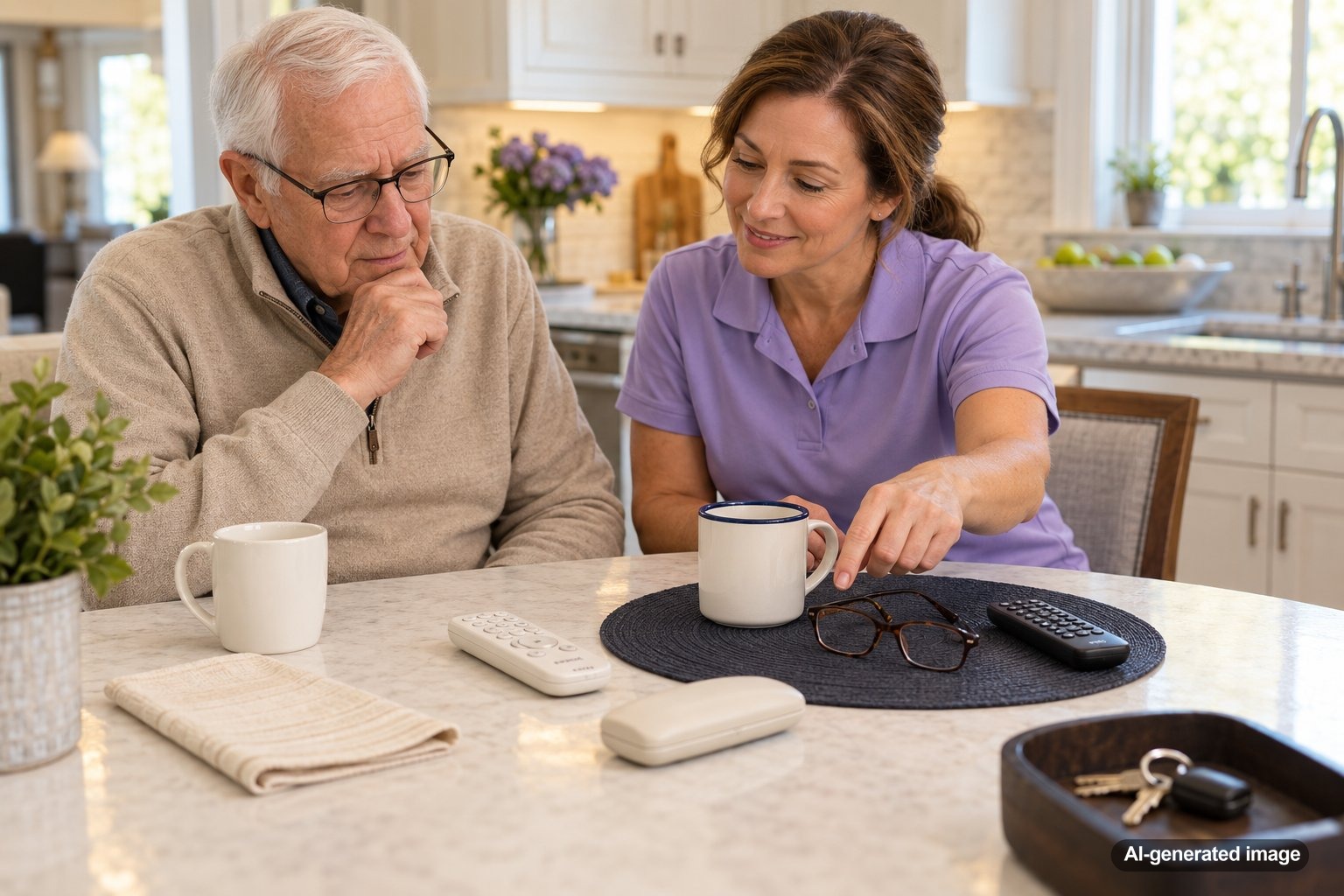
Poor contrast can make ordinary objects blend into their surroundings, which may make daily tasks more difficult for some older adults. A white light switch on a white wall, a clear drinking glass on a pale countertop, or a dark chair on a dark floor can be surprisingly easy to overlook when colors and edges do not stand out clearly.
Families can often make a home easier to use by creating stronger visual differences between important objects and their backgrounds. The goal is not to redesign the entire house. Small, thoughtful changes can support confidence, independence, and more comfortable daily routines.
Quick answer
- Objects can be harder to notice when their color or brightness closely matches the surface behind them.
- High-contrast choices can make commonly used items easier to locate during everyday routines.
- Useful places to improve contrast include stairs, bathrooms, kitchens, dining areas, doorways, and frequently used furniture.
- Changes should be simple, familiar, and comfortable for the older adult rather than making the home feel institutional.
- If changes in vision are new, significant, or interfering with daily function, a qualified healthcare or vision professional can provide individualized guidance.
Why contrast matters in everyday life
Contrast is the visual difference between an object and what surrounds it. When that difference is strong, the edge or shape of an object may be easier to recognize. When the colors are very similar, the object may seem to blend into the background.
Consider a beige plate on a beige placemat, a gray remote control on a gray sofa, or a light-colored grab bar against a similarly colored shower wall. None of these objects is actually hidden, but the lack of visual separation can make finding or identifying them more difficult.
This matters because aging in place depends partly on making everyday routines as clear and manageable as possible. Families thinking about support at home can look beyond basic task assistance and consider how lighting, organization, mobility, routines, and the home environment work together.
Signs or situations families can watch for
Difficulty with contrast does not always look like an obvious vision problem. Families may instead notice small changes in how an older adult interacts with familiar surroundings.
- Frequently searching for objects that are sitting in plain view.
- Reaching past the edge of a plate, cup, counter, or table.
- Hesitating where flooring changes between rooms.
- Having trouble identifying steps, especially when stair treads and surrounding flooring look similar.
- Overlooking switches, handles, controls, or personal items that match nearby surfaces.
- Preferring brighter lighting for reading, cooking, dressing, or other routine activities.
These situations can have many possible explanations. They should be treated as observations rather than a diagnosis. If a change is sudden, significant, or concerning, families can discuss it with an appropriate healthcare or vision professional.
Everyday places where better contrast may help
Dining areas
Plates, cups, placemats, and table surfaces can become visually similar when they share nearly the same color. Choosing tableware that stands out from the table or placemat can make the boundaries of items easier to identify. For example, a darker plate may stand out better on a light table, while a lighter dish may be more visible on a dark surface.
Bathrooms
Bathrooms often contain large areas of similar colors, such as white sinks, white counters, pale flooring, and light walls. Towels, bath mats, commonly used containers, and other frequently handled objects may be easier to locate when they contrast clearly with their surroundings.
Stairs and changes in floor level
Steps can be difficult to distinguish when every surface looks nearly identical. Consistent lighting and clear visual differences at changes in level can make the layout easier to interpret. Families should avoid making improvised modifications that create tripping hazards or interfere with secure footing.
Kitchens
Kitchen counters often hold small items such as utensils, cups, cutting tools, medication containers, food packages, and appliance controls. Keeping counters uncluttered and choosing frequently used items that are visually distinct from the work surface can make routines simpler.
Furniture and pathways
A chair, ottoman, side table, or other furniture piece may be less noticeable when it closely matches the floor or nearby walls. Clear pathways, consistent furniture placement, and noticeable visual boundaries can support easier navigation without requiring dramatic decorating changes.
How families can approach changes without taking over
Home modifications can be sensitive because familiar surroundings are closely tied to independence and personal preference. An older adult may understandably resist changes that make the home feel unfamiliar or suggest that someone else is taking control.
A collaborative approach is often more comfortable. Instead of announcing that the home needs to be changed, families can focus on one practical frustration at a time. A conversation might begin with a simple observation such as, “That remote seems to disappear into the sofa. Would a lighter cover make it easier to spot?”
Whenever possible, involve the older adult in choosing colors, placements, and organizational changes. The goal is to make daily life easier while preserving the person’s routines, preferences, and sense of ownership.
Practical ways to create clearer visual contrast
Families do not necessarily need specialized products. Many improvements can come from ordinary household choices.
- Use contrasting tableware: Choose plates, cups, or placemats that stand apart from the table and from the food being served.
- Make important controls noticeable: Frequently used switches, remotes, and appliance controls should be easy to distinguish from their surroundings.
- Reduce visual clutter: Too many objects competing for attention can make it harder to identify the item someone actually needs.
- Keep pathways visually clear: Avoid placing low-contrast objects, baskets, cords, or small furniture pieces in common walking areas.
- Use consistent organization: Keeping commonly used items in predictable locations can reduce the need to visually search for them.
- Improve lighting: Adequate, even lighting can complement contrast changes by making edges and surfaces easier to distinguish.
- Change one thing at a time: Small adjustments can be easier to accept and evaluate than a major redesign.
How home support can fit into the bigger picture
Visual contrast is one small part of a larger aging-in-place plan. A home may also need attention to routines, mobility, organization, personal care, companionship, family communication, and changing daily abilities.
Support at home can help families notice where routine activities are becoming frustrating and develop practical ways to make those routines more manageable. This may include keeping frequently used objects organized, maintaining clearer walking areas, reinforcing familiar routines, or helping family members communicate about changing needs.
When more specific functional concerns arise, an occupational therapy professional may evaluate how a person manages everyday activities and interacts with the home environment. Occupational Therapy often focuses on daily activities, home setup, adaptive strategies, and activities such as dressing, bathing, eating, and managing routines. Recommendations should be individualized to the person’s needs and environment.
When to involve a professional
If an older adult is increasingly having difficulty seeing objects, reading controls, recognizing changes in surfaces, or completing familiar activities, it may be worth discussing the change with a qualified healthcare or vision professional. A professional can evaluate factors that cannot be determined from home observations alone.
Families who are also noticing broader challenges with daily routines, mobility, organization, or independence may benefit from looking at the home as a whole rather than addressing each frustration separately. Coordinated aging-in-place support can help families think about daily function, comfort, safety, companionship, and changing needs together. Families can review Mind & Mobility locations when exploring available support in their area.
Frequently asked questions
What does poor contrast mean in a home?
Poor contrast means an object looks very similar in color or brightness to the surface around it. For example, a white switch on a white wall or a dark chair on dark flooring may be less visually distinct.
Do families need to use bright colors everywhere?
No. Contrast does not require making the home extremely colorful. The important idea is creating enough visual difference for important objects, edges, and surfaces to stand out. Neutral colors can still provide effective contrast when light and dark tones are used thoughtfully.
Should families replace furniture to improve contrast?
Usually not. Simple adjustments such as changing a throw, placemat, towel, object location, or storage method may create useful visual separation without replacing major household items.
Can better lighting help as much as stronger contrast?
Lighting and contrast often work together. Even strongly contrasting objects can be difficult to see in dim or uneven lighting. Families can consider both the visibility of the object and the lighting in the area where it is used.
What if an older adult does not want changes made to the home?
Start with a specific daily frustration and involve the person in deciding what, if anything, should change. Small adjustments that solve a noticeable problem may feel more respectful and useful than a large-scale home makeover.
Who can help evaluate difficulties with daily activities at home?
Depending on the concern, a healthcare or vision professional may evaluate changes in vision, while an occupational therapy professional may help assess how the home environment and daily activities work together. Families can also explore home support when routine tasks, organization, companionship, mobility, or family coordination are becoming harder to manage.
Need help supporting a loved one at home?
Mind & Mobility helps families explore care, therapy, mobility support, and aging-in-place options with dignity and compassion.
Prefer to call? 866-595-7086
Disclaimer
This article is for educational purposes only and is not medical, legal, insurance, or emergency advice. For personalized guidance, speak with a qualified healthcare professional or contact Mind & Mobility to discuss care options.