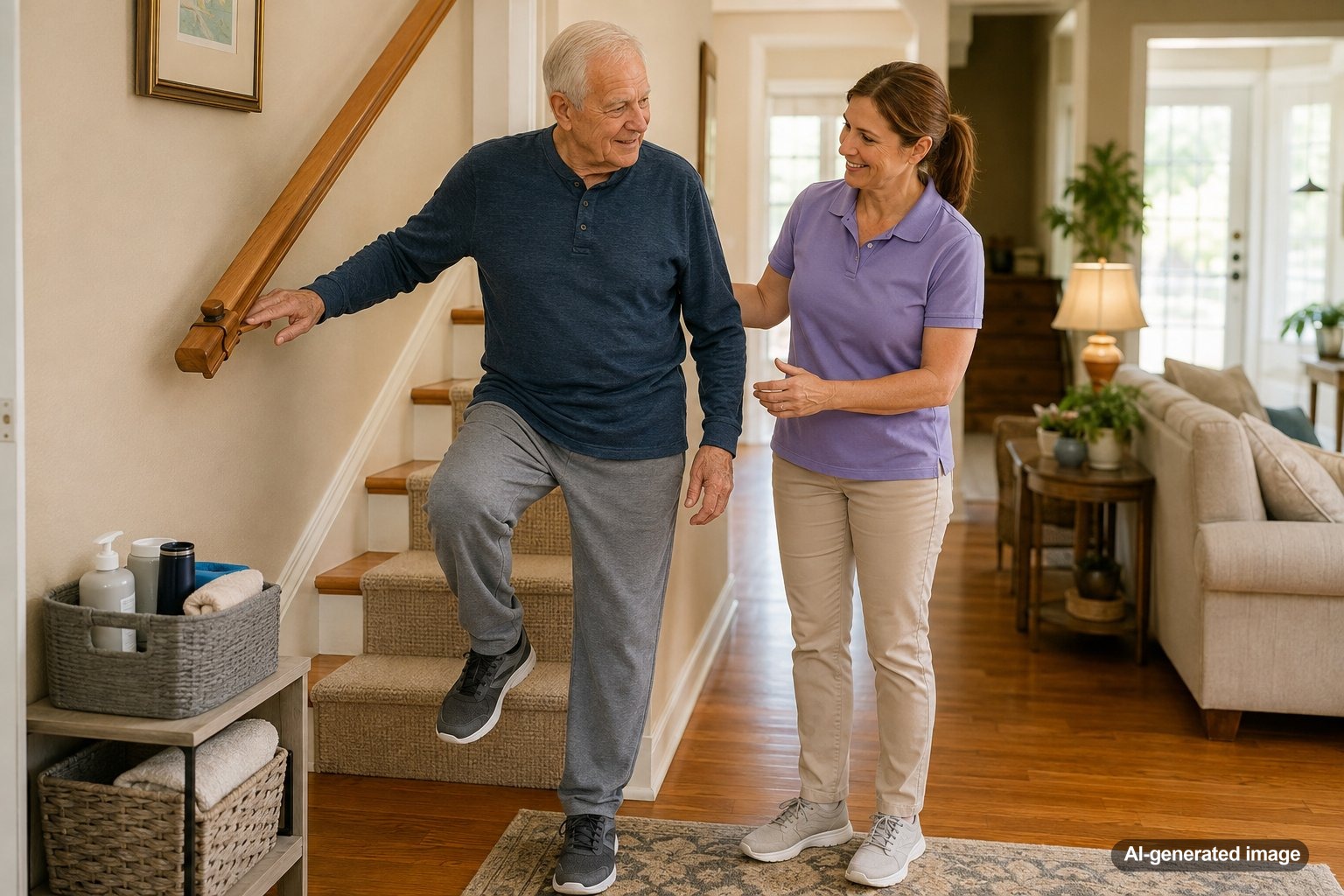
Carrying laundry, groceries, cleaning supplies, medications, and everyday belongings between floors can gradually become one of the harder parts of living in a multilevel home. A useful goal is not simply to become better at carrying things on stairs. It is to redesign routines so fewer items need to travel between floors in the first place.
For older adults who want to remain at home, small changes in storage, household routines, and room setup can make daily life easier while preserving independence. Families can often start with simple adjustments and then consider professional guidance if stairs or household tasks are becoming increasingly difficult.
Quick answer
- Keep frequently used supplies on every floor where they are needed.
- Create designated upstairs and downstairs storage so everyday objects have permanent homes.
- Reorganize laundry, groceries, cleaning, and personal routines to reduce unnecessary stair trips.
- Avoid carrying bulky loads that interfere with a person’s ability to move comfortably or use available hand support.
- If stairs or carrying tasks are becoming difficult, an occupational therapist or other qualified professional can evaluate the home and daily routines.
Start by identifying what is being carried most often
Before buying organizers or rearranging rooms, spend several days noticing what regularly travels between floors. Common examples include laundry, towels, cleaning products, water bottles, reading glasses, chargers, medications, toiletries, paperwork, shoes, and hobby supplies.
Once the pattern is clear, ask a simple question: Does this item truly need to move between floors? Many recurring stair trips happen because an object has only one storage location even though it is used in several areas of the home.
A small notebook or family discussion can help identify repeated trips. The goal is not to restrict independence. It is to remove unnecessary work from ordinary routines.
Duplicate inexpensive everyday supplies
One of the simplest strategies is keeping commonly used, affordable items on more than one level. Depending on the household, that might include tissues, basic toiletries, phone chargers, reading glasses, cleaning cloths, wastebasket liners, pet supplies, or other everyday necessities.
Duplicating a few supplies can be more practical than carrying the same basket or container upstairs and downstairs every day. This works especially well for items that are inexpensive, small, and used frequently.
Medication storage deserves more careful planning. Families should follow appropriate storage instructions and professional guidance rather than casually creating duplicate medication supplies.
Create an upstairs zone and a downstairs zone
A multilevel home can become easier to manage when each floor functions more independently. Think about what someone normally does upstairs and what happens downstairs, then store supplies close to those activities.
For example, bedroom linens and nighttime necessities can stay near bedrooms. Kitchen and dining items can remain near the kitchen. Frequently used paperwork, chargers, hobbies, and entertainment items can have a permanent home on the floor where they are normally used.
This approach supports aging in place because it organizes the environment around daily function instead of expecting the person to continually adapt to an inconvenient layout.
Rethink the laundry routine
Laundry is often one of the biggest reasons people carry bulky loads between levels. A traditional routine may involve collecting clothing upstairs, carrying a full hamper to another floor, completing several loads, and then carrying everything back.
Families may be able to simplify the process by using smaller loads, keeping hampers closer to where laundry is generated, storing some linens near their point of use, or having another household member or caregiver assist with transportation between floors when appropriate.
If laundry is located in a basement or another difficult-to-reach area, it may be worth discussing whether the current setup still supports the person’s abilities and routines. An occupational therapist can look at the activity as a whole, including carrying, reaching, navigating stairs, organizing supplies, and completing the task independently when possible.
Make grocery unloading a one-floor process when possible
Groceries can create repeated carrying demands, especially when pantry goods, beverages, household supplies, or extra food storage are located on another level. Consider whether frequently purchased items can be stored on the same floor as the kitchen.
Less frequently used bulk supplies can remain elsewhere if someone else can move them when necessary. Another option is breaking grocery unloading into smaller, manageable groups rather than trying to move everything at once.
The larger principle is to organize the home so routine deliveries and shopping create as little unnecessary stair traffic as reasonably possible.
Keep cleaning supplies where cleaning happens
A single large cleaning caddy may seem efficient, but it can require someone to carry bottles, sprays, cloths, and other supplies from floor to floor. A basic set of appropriate cleaning supplies on each main level can eliminate many of those trips.
Storage should remain appropriate for the household, particularly if children, pets, or someone with cognitive changes lives in or visits the home. The goal is convenient access without creating a new household hazard.
Reduce the size of loads
When an item does need to move between floors, smaller loads may be easier to manage than large baskets, boxes, or armfuls of belongings. Bulky objects can make it harder to see the steps, move naturally, or use available hand support.
Instead of asking, “How much can we carry in one trip?” a better question may be, “Can this trip be eliminated, delegated, or made less cumbersome?” Convenience matters, but maintaining comfortable movement and attention while using stairs matters more.
Move frequently used belongings to easier-to-reach storage
Reducing stair trips and reducing unnecessary reaching can be addressed together. Frequently used items are generally easier to manage when they are stored where the person can access them comfortably rather than in remote closets, high shelves, basement storage, or seldom-used rooms.
The National Council on Aging recommends considering home modifications and storage changes as part of aging-in-place planning, including keeping frequently used belongings in easier-to-access locations. Small organizational changes can sometimes improve the usefulness of an existing home without requiring major renovation.
Consider whether key daily activities need to happen on multiple floors
Sometimes the larger issue is not what is being carried but how often someone must change floors to complete ordinary activities. If a person goes upstairs repeatedly for clothing, toiletries, paperwork, rest, or other essentials, families may want to consider whether some activities can be consolidated onto one main level.
This does not automatically mean converting the entire home or giving up favorite rooms. It can mean creating a convenient daytime setup on the main floor, keeping essential supplies nearby, or moving selected routines to more accessible spaces.
An occupational therapist may help families examine how the home environment supports daily activities. Occupational Therapy (OT) commonly focuses on everyday tasks, routines, home setup, adaptive strategies, and activities of daily living. That perspective can be useful when a familiar house no longer fits daily routines as comfortably as it once did.
Coordinate help around the tasks that create the most stair traffic
Family support or home care does not have to replace everything an older adult does independently. It can focus on the tasks that have become disproportionately demanding, such as moving laundry, carrying bulk groceries, changing bedding, transporting household supplies, or reorganizing storage.
This is where coordinated aging-in-place support can be helpful. Instead of viewing assistance only as task coverage, families can build support around routines, mobility, confidence, home setup, companionship, and changing needs. A caregiver might handle heavier household transportation while the older adult continues participating in the parts of the routine that remain comfortable and meaningful.
Families exploring broader support can learn more about Mind & Mobility and its approach to helping older adults remain supported at home.
Why reducing stair-related carrying can matter
Stairs are easier to navigate when attention can remain on movement rather than balancing an awkward load. Home safety guidance for older adults commonly emphasizes clear stairways, adequate lighting, accessible hand support, and reducing household hazards.
Reorganizing routines can complement those environmental changes. A well-lit staircase is useful, but it does not eliminate the practical challenge of carrying a full laundry basket between floors. Looking at both the environment and the activity itself creates a more complete aging-at-home plan.
Signs or situations families may want to notice
It may be worth taking a closer look at household routines when an older adult begins avoiding certain floors, leaving items on stairs for later, making repeated trips because belongings are stored inconveniently, struggling with bulky laundry or grocery loads, or relying increasingly on furniture or walls while moving through the home.
These observations do not establish a diagnosis or automatically mean a specific service is needed. They can simply indicate that the home’s organization deserves another look.
Families may also notice that a once-manageable routine now consumes much more energy. Changing the routine early can be more practical than waiting until everyday tasks become frustrating.
How families can approach the conversation
Changes to a longtime home can feel personal. A parent or spouse may hear suggestions about moving supplies or accepting help as criticism of their abilities. Framing matters.
Instead of saying, “You shouldn’t be carrying things anymore,” try focusing on convenience: “What could we keep upstairs so you don’t have to make extra trips?” or “Would it make life easier if we kept cleaning supplies on both floors?”
Whenever possible, involve the older adult in deciding what changes make sense. The objective is to support independence and dignity by making the home work better for the person who lives there.
When to involve a professional
If stair use, carrying, walking, balance, strength, or daily household activities are becoming more difficult, a qualified professional can evaluate the situation and provide individualized guidance.
Physical Therapy (PT) often focuses on walking, balance, mobility, transfers, movement strength, and confidence with movement. Occupational Therapy (OT) often focuses on daily activities, household routines, home setup, adaptive strategies, and tasks such as dressing, bathing, preparing meals, and managing the home. Depending on the concern, these disciplines can offer different but complementary perspectives.
Professional input may be particularly useful when families are considering significant changes to a multilevel home’s layout or when ordinary routines have become difficult to manage. Families can also explore Mind & Mobility locations when looking for support within available service areas.
Frequently asked questions
What is the easiest way to reduce trips up and down stairs?
Start by identifying the items carried most frequently and give those belongings permanent storage on each floor where they are used. Duplicating inexpensive supplies and reorganizing laundry, cleaning, and personal routines can often eliminate repeated trips.
Should an older adult carry a laundry basket on the stairs?
There is no single answer that fits everyone. Abilities, stair design, the size of the load, and individual circumstances differ. If carrying laundry interferes with comfortable movement, visibility, or available hand support, consider changing the routine or asking a qualified professional to evaluate safer alternatives.
Can home organization really make aging in place easier?
It may help. Aging in place is not only about major renovations. Storage location, lighting, clear pathways, convenient routines, and reducing unnecessary physical demands can all influence how easily someone manages daily life at home.
Who can evaluate household routines for an older adult?
Occupational therapists commonly evaluate how people perform everyday activities within their home environment. Depending on the concern, a physical therapist or another qualified healthcare professional may also contribute to evaluating mobility and movement needs.
Does accepting help with stair-related chores mean giving up independence?
No. Selective support can be used to preserve energy and make daily routines more manageable while an older adult continues doing activities that are comfortable and meaningful. The amount and type of support should reflect the person’s preferences and needs.
Need help supporting a loved one at home?
Mind & Mobility helps families explore care, therapy, mobility support, and aging-in-place options with dignity and compassion.
Prefer to call? 866-595-7086
Disclaimer
This article is for educational purposes only and is not medical, legal, insurance, or emergency advice. For personalized guidance, speak with a qualified healthcare professional or contact Mind & Mobility to discuss care options.