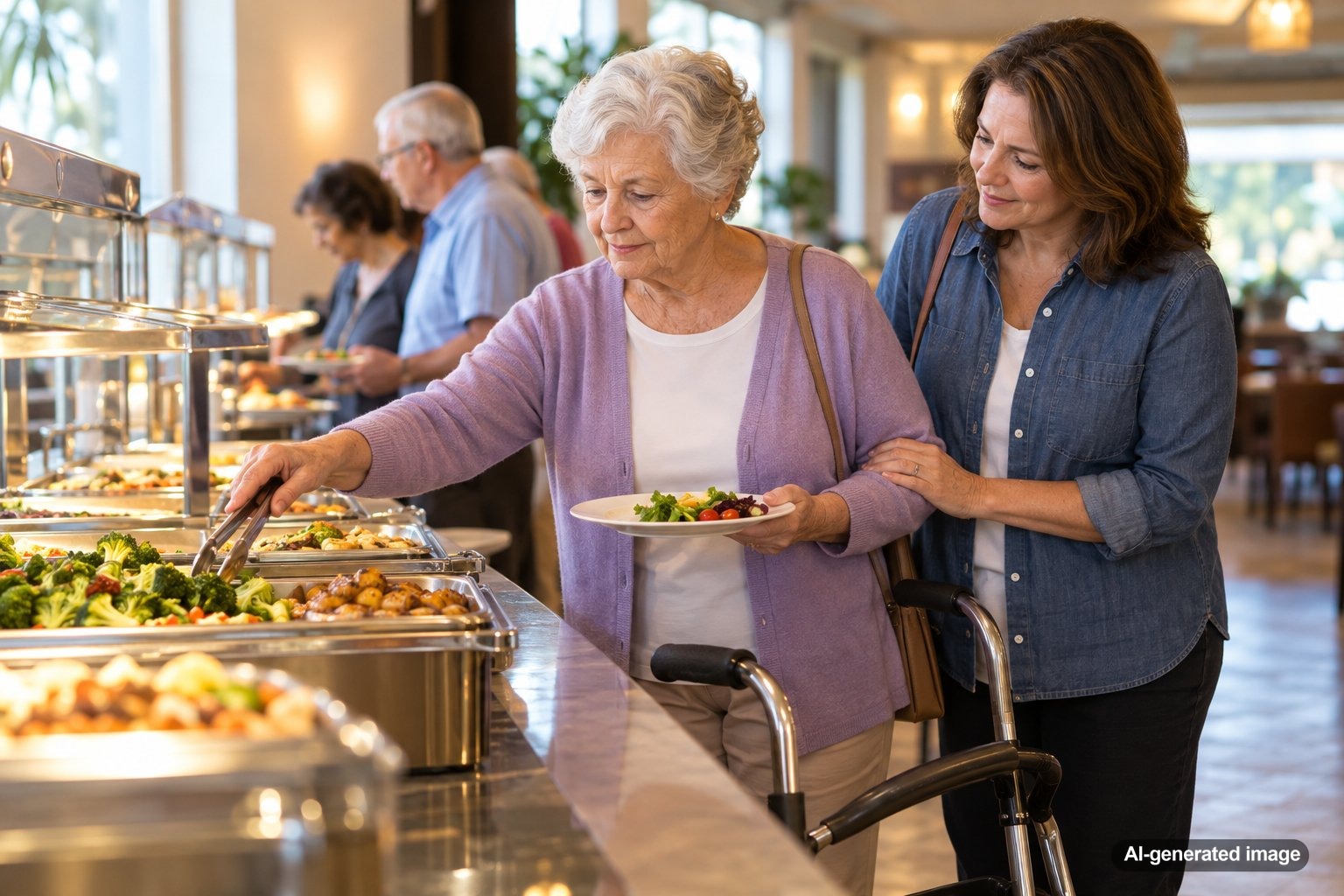
A buffet may look like a simple way to enjoy a meal, but it can require much more mobility than families realize. An older adult may need to stand for several minutes, move slowly through a crowded line, reach for food, carry a plate, turn around other guests, and locate a seat without having a convenient place to rest.
When walking, balance, strength, endurance, or confidence has changed, those combined demands can make a buffet uncomfortable or exhausting. That does not necessarily mean an older adult should stop attending restaurants, celebrations, or family gatherings. A few thoughtful adjustments can make the experience easier while preserving choice, dignity, and independence.
Quick answer
- Buffet lines combine standing, walking, reaching, turning, and carrying items at the same time.
- Crowded spaces and unpredictable movement from other guests can make navigation more demanding.
- An older adult who normally walks comfortably may still struggle when carrying a plate or waiting without a place to sit.
- Family members can help by reducing unnecessary standing, carrying items when requested, and choosing seating that is easy to reach.
- Notice whether similar challenges are appearing in other everyday activities, because that information can be useful when discussing mobility with a qualified professional.
Why a buffet line can require more mobility than it seems
Buffets involve several tasks that usually happen one after another. A person may walk from the table to the serving area, stand while waiting, take small sideways steps, reach for utensils, lean toward serving dishes, carry a plate, change direction, and then walk back through a busy dining room.
Each individual movement may seem minor. The difficulty can come from combining them. Someone who walks well when both hands are free may feel less steady while carrying a plate. Someone who can stand comfortably for a short conversation may become tired while waiting in a slow-moving line.
Standing still can sometimes be harder than walking
Families often focus on how far an older loved one can walk. Standing tolerance matters too. Buffet lines may move slowly, leaving a person standing in one place without a chair, railing, or other comfortable support nearby.
An older adult may begin shifting weight, leaning on the counter, looking for a place to sit, or choosing fewer foods simply to leave the line sooner. These behaviors can be practical ways of managing fatigue rather than signs that the person has lost interest in the meal.
Carrying a plate changes the task
Holding a plate occupies at least one hand. That can matter for someone who normally uses a cane, walker, railing, furniture, or another stable surface for support. Carrying food can also divide attention between walking, keeping the plate level, watching other people, and deciding where to go next.
Families can avoid making assumptions about what help is needed. A simple question such as, Would you like me to carry your plate while you choose what you want? allows support without taking over the entire experience.
Reaching, turning, and serving food add another challenge
Buffet dishes are not always positioned conveniently. Some require reaching forward, lifting lids, using serving utensils, or turning while holding a plate. The combination may feel awkward for someone experiencing changes in strength, balance, hand function, or range of motion.
It may be easier for a family member to handle a heavy serving utensil, hold the plate, or bring a requested item to the table. The goal is not to make every decision for the older adult. It is to remove the part of the task that is unnecessarily difficult while allowing the person to remain involved.
Crowds can make movement less predictable
Restaurants, weddings, holiday meals, hotel breakfasts, and community events can create busy buffet areas. People may step backward unexpectedly, children may move quickly between adults, chairs may narrow walking paths, and the line may stop without warning.
For someone who already takes more time to turn or regain balance after stopping, that environment can require extra concentration. Going through the line during a quieter moment or choosing a less crowded route can make the experience more manageable.
Why this matters for families
A buffet can reveal functional challenges that are less obvious at home. Daily routines are often highly familiar. An older adult may know exactly where furniture is located, how far it is from the kitchen to the living room, and which surfaces are available for support. An unfamiliar dining room removes many of those predictable cues.
If a loved one suddenly seems hesitant at a buffet, it can be helpful to observe without immediately interpreting the behavior as stubbornness or withdrawal. They may simply be calculating how to complete a physically complicated task safely and comfortably.
Situations families may want to notice
One difficult buffet experience does not establish a medical condition. However, families may find it useful to notice whether the same kinds of challenges are appearing elsewhere.
- Needing to sit after shorter periods of standing than before
- Moving more cautiously in crowded places
- Having difficulty carrying objects while walking
- Using furniture or counters more often for support
- Avoiding activities that require standing in line
- Having more difficulty with turning, reaching, or changing direction
- Appearing much more tired after outings that were previously manageable
Patterns across several daily activities can provide more useful information than a single event.
How families can approach the conversation
Mobility changes can be personal. An older adult may worry that mentioning difficulty will lead family members to restrict activities or make decisions without them. Starting with the immediate situation can feel less threatening than making broad statements about independence.
For example, a family member might say, That line looked tiring. Next time, would it be easier if I carried the plate or brought things back for you? This focuses on solving a practical problem rather than labeling the person.
The same approach can be useful at home. Ask what part of an activity feels difficult and what kind of assistance would actually be useful. Support is often more acceptable when the older adult remains part of the decision.
Practical ways to make buffet meals easier
- Choose an accessible table. A seat with a clear route to the buffet, restroom, and exit can reduce unnecessary walking through crowded areas.
- Limit waiting when possible. Going through the line before it becomes crowded or after the initial rush may reduce standing time.
- Offer to carry the plate. The older adult can still choose the food while another person handles the carrying.
- Bring food to the table when preferred. This can be especially helpful when the buffet requires multiple trips.
- Leave mobility aids within easy reach. Do not move a cane, walker, or other aid away simply because it is inconvenient for the table setup.
- Allow extra time. Rushing can make an already complicated activity feel more stressful.
- Respect changing plans. Someone may decide that sitting and having another person bring food is more enjoyable than navigating the line.
How mobility support can fit into a broader aging-at-home plan
Challenges that appear during outings may also affect routines at home, including meal preparation, carrying laundry, moving between rooms, bathing, dressing, or getting in and out of chairs. Families do not have to wait until daily life becomes overwhelming before discussing support.
A coordinated aging-in-place approach can look at the whole routine rather than one isolated task. Depending on a person’s needs, that may include home care, companionship, safer routines, mobility awareness, family coordination, and therapy when clinically appropriate. Families can learn more about Mind & Mobility or review Mind & Mobility service locations.
When to involve a professional
If changes in walking, balance, standing tolerance, strength, or everyday movement are becoming more noticeable, it may be worth discussing them with a qualified healthcare professional. A professional can evaluate the person’s individual circumstances rather than relying on observations from one outing.
Physical Therapy, or PT, often focuses on areas such as walking, balance, movement confidence, transfers, and strength. Occupational Therapy, or OT, often looks at how physical changes affect practical daily activities and how routines or environments might be adapted. The appropriate approach depends on the individual and should be based on professional evaluation when needs are specific.
Frequently asked questions
Why can an older adult walk normally but struggle in a buffet line?
A buffet combines several activities at once, including standing, carrying, reaching, turning, navigating people, and making decisions. A person may manage straightforward walking comfortably while finding this combination more demanding.
Should family members automatically bring food to the table?
Not necessarily. Ask what the older adult prefers. Some people may want assistance carrying a plate while still selecting their own food. Others may prefer having the entire meal brought to them.
Can fatigue make buffet lines harder?
Yes. Long outings, standing, walking, conversation, heat, travel, and other demands can affect how manageable an activity feels. An older adult may have different abilities at different times of day or on different days.
What if a loved one refuses help?
Try offering a specific type of assistance rather than taking over. Asking whether you can carry the plate, hold a serving utensil, or save a nearby seat may feel more respectful than insisting that the person avoid the buffet entirely.
When should mobility changes be professionally evaluated?
If changes are persistent, worsening, affecting multiple daily activities, or causing concern, a qualified healthcare professional can evaluate the situation. Families can share specific examples of what they have noticed, including difficulty standing, turning, walking, or carrying items.
Need help supporting a loved one at home?
Mind & Mobility helps families explore care, therapy, mobility support, and aging-in-place options with dignity and compassion.
Prefer to call? 866-595-7086
Disclaimer
This article is for educational purposes only and is not medical, legal, insurance, or emergency advice. For personalized guidance, speak with a qualified healthcare professional or contact Mind & Mobility to discuss care options.