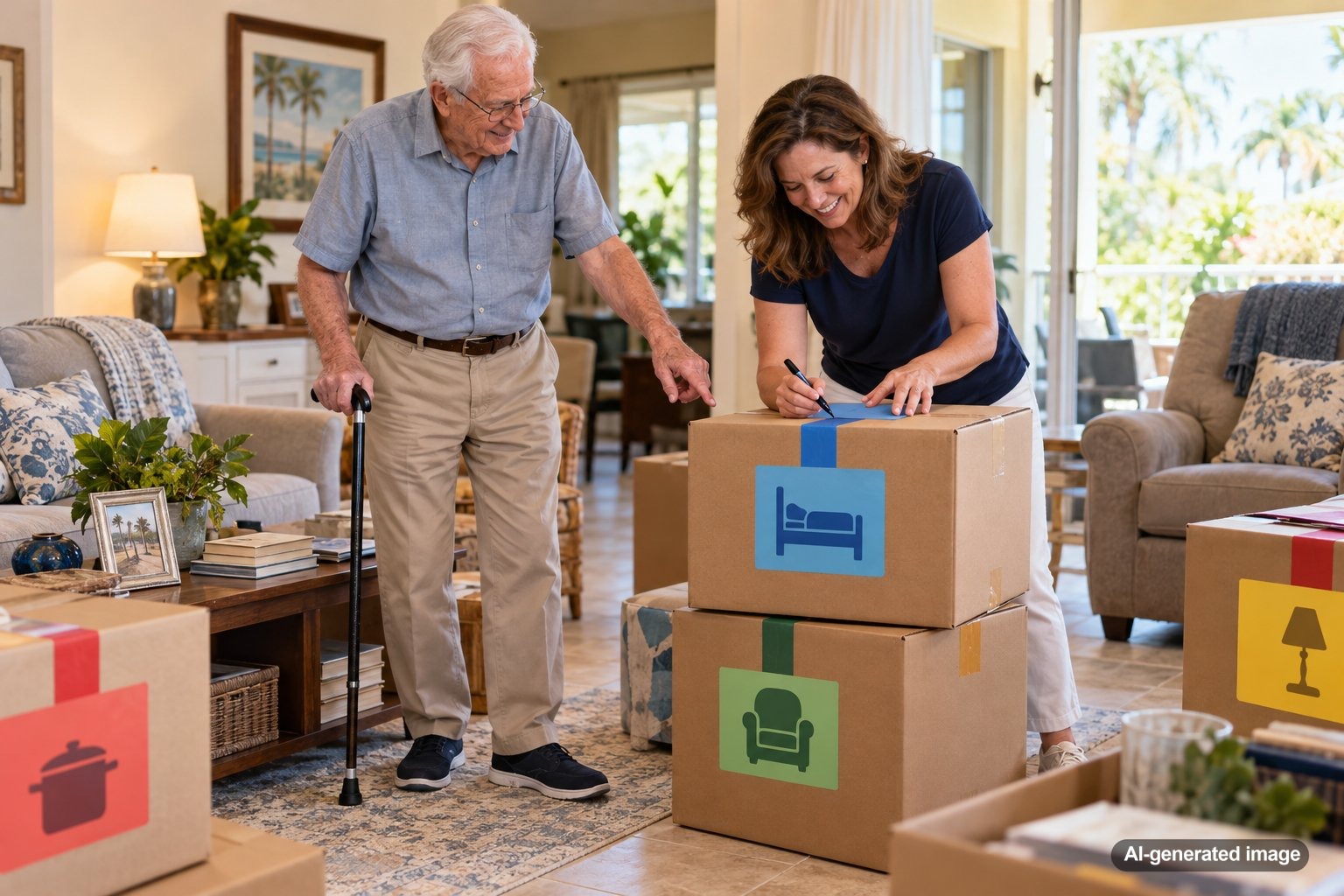
Moving an older loved one into a different home, a smaller apartment, or a family member’s house involves much more than packing dishes and clothing. Familiar belongings, everyday routines, and the ability to find things without asking for help can make a new space feel more comfortable. Even a carefully planned move may feel unsettling when favorite objects disappear into identical cardboard boxes.
The most helpful way to label moving boxes for an older adult who needs familiarity is to use large, readable labels that identify both the destination room and the familiar contents inside. Instead of relying on box numbers or broad categories, describe belongings using the names your loved one already recognizes. Add simple unpacking priorities, keep important daily items together, and involve the older adult in decisions whenever possible. These small organizational choices can help preserve a sense of independence during a major life transition.
Quick answer
- Use familiar descriptions: Write ‘Mom’s blue bedroom blanket’ instead of simply ‘Bedding.’
- Make labels easy to read: Use large, dark lettering on a light background and place labels on multiple sides of each box.
- Identify the destination: Mark the room where each box belongs, using the room names your loved one understands.
- Highlight daily essentials: Clearly identify boxes containing important comfort items, clothing, and frequently used belongings.
- Unpack familiar spaces first: Prioritize the bedroom, bathroom, and favorite sitting area so recognizable routines can resume more easily.
Why familiar labels matter during an older adult’s move
For many older adults, the home is closely connected to daily habits and personal identity. A particular chair may be where someone reads the newspaper every morning. A familiar bedside lamp may be part of an evening routine. A favorite coffee mug may have been used for decades.
When these belongings are packed, even temporarily, the older adult may feel that ordinary life has become harder to manage. Labels such as ‘Miscellaneous,’ ‘Decor,’ or ‘Bedroom 2’ may make sense to the person organizing the move but offer little reassurance to someone looking for a specific, meaningful item.
Descriptive moving box labels help connect belongings to the routines and spaces where they belong. They also make it easier for adult children, professional movers, and other helpers to place items correctly without repeatedly asking where everything goes.
Most importantly, familiar labels can give an older adult a way to participate. Someone who prefers not to carry boxes may still enjoy reviewing labels, identifying favorite possessions, and helping decide which belongings should be unpacked first.
Start with the room names your loved one already uses
Before packing, agree on simple names for the rooms in the new home. If your loved one calls the living room ‘the sitting room,’ consider using that wording rather than introducing an unfamiliar name.
When possible, use the same room names on boxes and on removable signs outside the corresponding rooms. This creates a clear connection between where an item is packed and where it will eventually be placed.
For example, a box might say:
- BEDROOM: Nightstand items and reading lamp.
- KITCHEN: Everyday coffee mugs and breakfast dishes.
- SITTING ROOM: Family photo albums and favorite books.
- BATHROOM: Daily toiletries and clean hand towels.
If the new home has a different layout, walk through the space together before moving day or review simple photographs of the rooms. Explain where familiar furniture and belongings will go. The goal is to connect the new environment with routines your loved one already understands.
Describe what is inside, not just the type of object
Specific descriptions are often more useful than general inventory labels. A box marked ‘Linens’ could contain anything from guest towels to a treasured quilt. A label reading ‘Green quilt from old bedroom’ immediately identifies something recognizable.
Consider these examples:
| Generic label | More familiar label |
|---|---|
| Clothes | Everyday sweaters and blue cardigan |
| Kitchen | Morning coffee mugs and cereal bowls |
| Decorations | Family wedding photos and mantel clock |
| Books | Favorite mystery novels from bedside shelf |
| Miscellaneous | Knitting basket, yarn, and reading glasses case |
These longer descriptions are especially helpful when several people are assisting with the move. They reduce guesswork and make it easier to locate meaningful belongings without opening every container.
Keep labels accurate. If the contents change during packing, update the description immediately rather than assuming someone will remember what was moved.
Use large lettering and a consistent labeling system
A practical labeling system should be easy to understand at a glance. Choose a dark, thick marker and plain white or light-colored labels. Avoid decorative lettering, tiny writing, or abbreviations that might be difficult to interpret.
Each box should ideally have three pieces of information:
- Destination room: The room where the box belongs.
- Familiar contents: A short description of recognizable items inside.
- Unpacking priority: Whether the contents are needed immediately, soon, or later.
Place labels on the top and at least two sides of each box. A side label remains visible when boxes are stacked, making it easier to locate specific items without moving heavy containers.
Color coding can offer another visual clue. For example, bedroom boxes might have blue tape, kitchen boxes green tape, and sitting room boxes yellow tape. However, color should supplement written labels, not replace them. This makes the system more accessible to people who have difficulty distinguishing colors or remembering what each color means.
Create a special category for familiar daily essentials
Not every moving box deserves the same unpacking priority. Some belongings directly support everyday routines and comfort. These should be clearly identified and kept accessible.
Use a consistent label such as ‘OPEN FIRST – DAILY COMFORT ITEMS’ and include a familiar description of the contents.
Depending on your loved one’s preferences, priority items might include:
- A favorite blanket, pillow, or familiar bedspread.
- Everyday clothing, comfortable shoes, and sleepwear.
- Reading glasses, books, crossword puzzles, or hobby supplies.
- Frequently used dishes, cups, and breakfast items.
- Family photographs and a familiar bedside clock.
- Basic toiletries and personal grooming supplies.
- Commonly used remote controls and their corresponding devices.
Keep medications, important documents, identification, mobility aids, and other immediately necessary personal items under the supervision of the older adult or a designated family member rather than in ordinary moving boxes. Maintain any required storage conditions and follow applicable professional guidance for medical supplies.
Consider preparing a separate overnight bag with clothing, toiletries, and familiar comfort items. That way, your loved one does not need to search through boxes to complete the first evening and morning routines.
Keep familiar objects together when possible
Families often pack by category because it seems efficient. All books go into one set of boxes, all decorative objects into another, and all linens into a third. However, this approach can separate the items that an older adult associates with a particular activity.
Whenever practical, consider packing small groups of belongings according to how they are used together.
For example, a bedside routine box could contain the reading lamp, favorite book, clock, and a small framed photograph. A morning coffee box might contain familiar mugs, placemats, and commonly used breakfast dishes.
Clearly identify these containers with labels such as ‘BEDROOM – Bedside routine’ or ‘KITCHEN – Morning coffee setup.’
For fragile or valuable items, use appropriate protective packing and handling. The goal is to preserve familiar groupings when practical, not to sacrifice safe packing.
Include the older adult in labeling decisions
Moving can involve many decisions made by other people. Adult children may coordinate the movers, choose packing supplies, arrange transportation, and determine what furniture fits in the new home. Even when everyone has good intentions, the older adult may feel that too much is happening without their input.
Invite your loved one to help with labeling at a comfortable pace. Ask questions such as:
- ‘What would you call this box so you could recognize it later?’
- ‘Which things would you like to have out on the first day?’
- ‘Where would you like your favorite photographs to go?’
- ‘Would you rather have your bedroom arranged first or your sitting area?’
Offer manageable choices instead of presenting an overwhelming collection of decisions. Someone may prefer to identify the contents while another family member writes the labels or handles physical packing.
Respect personal naming habits. If a loved one has always called a particular cabinet ‘the china cupboard,’ that phrase can be more meaningful than ‘dining room storage.’
Including the older adult in practical decisions supports a sense of ownership over the move and helps the family understand which belongings matter most.
Take photographs of familiar arrangements before packing
Photographs can be useful companions to written labels. Before disconnecting lamps or moving furniture, take pictures of important arrangements that your loved one would like to recreate.
Useful photographs might include the bedside table, favorite reading corner, familiar living room shelves, or everyday kitchen setup.
Keep these photographs in a private album that can be accessed during unpacking. If helpful, give boxes matching numbers that correspond to the pictures, while retaining the descriptive written labels.
Pictures can also guide helpers who were not present when the original home was packed. Rather than guessing where a familiar clock or photograph belongs, they can refer to the arrangement your loved one preferred.
Ask permission before photographing personal belongings or sharing those pictures with others. The purpose is to support the move while respecting privacy and individual preferences.
Signs that the labeling system may need to be simpler
Even a well-organized moving plan can become difficult to follow when someone is tired, stressed, or navigating an unfamiliar environment.
Watch for practical clues that the system is not working as intended:
- Your loved one repeatedly asks where the same familiar object has been packed.
- Labels are difficult to read from a comfortable viewing distance.
- Room names on boxes do not match the names used in the new home.
- Too many categories, colors, or numbers create uncertainty.
- Important daily belongings are scattered across several boxes.
- The unpacking process is moving faster than your loved one feels comfortable managing.
These situations do not necessarily indicate a memory problem or a need for clinical care. They may simply mean that the labeling method is too complicated or that the move has become tiring.
Try reducing the number of categories, using larger lettering, and keeping the most important belongings visible and accessible. If your loved one has known vision, mobility, or cognitive needs, adapt the system around those needs rather than expecting them to learn an elaborate new method.
How to discuss packing without making your loved one feel rushed
Conversations about moving can become emotional, particularly when the move involves downsizing or leaving a longtime family home.
Rather than focusing only on efficiency, explain how labeling can help preserve familiar routines. For example, you might say, ‘I want to make sure we can find your favorite things right away, so the new bedroom feels like yours.’
Ask before packing meaningful objects. Avoid dismissing belongings as clutter simply because they appear unimportant to someone else. A worn cookbook or inexpensive picture frame may carry memories that are not immediately obvious.
It can also help to divide packing into shorter sessions, with breaks and opportunities to revisit decisions. If an item is emotionally difficult to pack, consider leaving it out until later when doing so is practical.
When disagreements arise, return to the shared goal: making the new living space comfortable, recognizable, and manageable. A move does not need to be completed through constant negotiation or pressure.
Unpack in an order that restores familiar routines
Moving boxes are only useful if the labeling system guides the unpacking process. Before moving day, identify the spaces and belongings your loved one will need first.
Start with the bedroom
Arrange the bed with familiar bedding, place frequently used belongings within comfortable reach, and set up the bedside lamp and clock where your loved one prefers them. Keep walking paths clear and avoid leaving boxes in areas used to get in or out of bed.
Prepare the bathroom
Unpack everyday toiletries, towels, and personal care items. Place supplies where they can be reached without unnecessary stretching or bending. If your loved one has difficulty with transfers, balance, or daily activities, a qualified professional can help evaluate the new setup.
Set up a favorite sitting area
If possible, arrange a familiar chair, reading lamp, photographs, and commonly used belongings in a comfortable location. These items can create a recognizable place to relax while the rest of the home is being organized.
Restore the kitchen routine
Unpack frequently used dishes and breakfast supplies before less essential kitchen items. Consider how your loved one normally prepares food and beverages, and avoid placing everyday objects on unusually high or low shelves.
There is no single unpacking order that works for every household. Ask which room or activity matters most to your loved one and adjust the sequence accordingly.
Practical ways support at home may help during a move
Some families can coordinate packing and unpacking independently. Others are balancing jobs, caregiving responsibilities, long-distance travel, and the needs of several family members. Additional help may make the transition more manageable.
Depending on the individual’s preferences and needs, home support may include assistance organizing daily belongings, establishing familiar routines, providing companionship during the transition, and communicating practical concerns to family members.
For an older adult who is adjusting to a new home, coordinated aging-in-place support can involve more than having someone available for individual household tasks. It may include attention to comfort, safe movement, daily function, family communication, and how routines change in the new environment.
For example, a caregiver may help keep frequently used belongings organized and support preferred daily activities within the agreed scope of care. When physical or functional concerns arise, a qualified professional can assess whether additional strategies would be useful.
Families exploring broader support options can learn more about Mind & Mobility’s approach to supporting older adults at home.
When to involve a professional
A move sometimes reveals challenges that were less noticeable in a familiar home. A loved one may find that the new bathroom is harder to navigate, the distance between rooms feels tiring, or everyday belongings are difficult to reach.
If these difficulties persist or interfere with daily activities, consider discussing them with a qualified healthcare professional.
An occupational therapist may help evaluate daily activities, home organization, accessible storage, and practical adaptations for dressing, bathing, or other routines. A physical therapist may assess walking, balance, transfers, strength, and movement confidence when appropriate.
If there are ongoing concerns about memory, communication, or understanding instructions, a healthcare professional can determine whether further evaluation is appropriate. Difficulties during a stressful move should not automatically be interpreted as a particular diagnosis.
For families who need help coordinating everyday support after relocation, it may also be useful to discuss companionship, home care, and family-centered planning options. The appropriate level of support depends on the person’s abilities, preferences, and circumstances.
Frequently asked questions
What is the best way to label moving boxes for an elderly parent?
Use large, readable labels with the destination room, familiar contents, and unpacking priority. Include descriptions that your parent personally recognizes, such as ‘Favorite blue blanket and bedroom pillows’ instead of ‘Linens.’ Put labels on several sides of each box so they remain visible when stacked.
Should I use colors or words to label moving boxes?
Use both if color coding is helpful, but always include clear written descriptions. Colors alone can be confusing when there are too many categories or when someone has difficulty distinguishing shades. Familiar words and consistent room names are usually a more dependable foundation.
How can I make unpacking less overwhelming for an older adult?
Unpack essential rooms and familiar belongings first, work in manageable sessions, and ask which items your loved one wants nearby. Avoid opening many boxes at once if doing so creates clutter. Keeping pathways clear and restoring predictable routines can make the process easier to navigate.
What should I pack separately for the first night?
Prepare an accessible overnight bag with comfortable clothing, sleepwear, toiletries, and familiar personal items. Keep medications, important documents, required medical supplies, and necessary mobility aids appropriately secured and readily available rather than burying them in ordinary moving boxes.
How should I label boxes if my loved one has memory difficulties?
Keep labels short, consistent, and personally meaningful. Use the same room names throughout the move and consider pairing written labels with photographs of familiar belongings. Limit unnecessary categories and involve your loved one at a comfortable pace. For ongoing memory concerns, seek guidance from an appropriate healthcare professional rather than relying on organizational changes alone.
Can home care help an older adult settle into a new home?
Depending on the individual’s needs and the services available, home support may help with everyday routines, companionship, personal care, and practical organization after a move. Family-centered planning can also help identify changing needs and coordinate additional professional guidance when appropriate. The goal is to support comfort, dignity, and as much independence as practical.
Make the new home feel familiar, one box at a time
Thoughtful moving box labels do more than tell movers which room to enter. They help families protect the everyday connections between meaningful belongings, established routines, and personal independence.
Start with familiar names, use readable descriptions, identify essential boxes clearly, and invite your loved one to participate in decisions. Then unpack the rooms and possessions that make daily life feel recognizable before worrying about perfect organization.
A successful move is not simply one where every box is emptied quickly. It is a transition that respects the older adult’s preferences and creates a living space where familiar activities can continue with comfort and confidence.
Need help supporting a loved one at home?
Mind & Mobility helps families explore care, therapy, mobility support, and aging-in-place options with dignity and compassion.
Prefer to call? 866-595-7086
Disclaimer
This article is for educational purposes only and is not medical, legal, insurance, or emergency advice. For personalized guidance, speak with a qualified healthcare professional or contact Mind & Mobility to discuss care options.